According to 2023 CDC data, 24.3% of U.S. adults live with chronic pain, and 8.5% of adults experience high-impact chronic pain that frequently limits life or work activities. Many of them have already tried the standard options by the time they start reading cannabis labels. That’s a big reason terpenes, the aromatic compounds that give cannabis its scent, get so much attention. If a peppery or citrusy molecule in the plant could influence how the body handles discomfort, it would change how people choose products.
The research is real and growing. Most of it, though, comes from lab dishes and animal studies rather than people. An honest guide to the best terpenes for pain has to separate what’s been shown from what’s still being explored, and that’s what this one does.
An Honest Look at Terpenes and Pain
Terpenes are small aromatic compounds made by thousands of plants. They likely evolved to repel pests and attract pollinators, and they’re why lavender smells floral, why black pepper smells sharp, and why two cannabis strains with the same THC percentage can smell completely different. In cannabis, terpenes are produced in the same tiny resin glands, called trichomes, that make THC and CBD. The plant produces more than 100 of them, usually in small amounts, often around 1% to 3% of a flower’s dry weight.
So do terpenes help with pain?
In animals, several of them clearly change how pain signals behave. A 2025 review in Pharmaceuticals summarized the main ways this seems to happen: activating CB2 receptors, modulating TRP and adenosine receptors, and inhibiting inflammatory signaling pathways such as NF-κB and COX-2. The full review, Phytochemical Modulators of Nociception, is worth reading if you want the complete scientific picture. Its authors were also candid about the limits, noting that inconsistent study methods, a lack of standardized formulations, and too little data on how terpenes move through the body hold back translation into clinical care.
That caveat matters more than it might seem. Many lists of the best terpenes for pain treat every compound as equally proven, but the evidence varies widely from one terpene to the next. Animal studies also tend to inject a single purified terpene at a carefully measured dose, while people inhale or swallow a mix of dozens of compounds at much smaller amounts.
For example, a University of Arizona team found that terpenes relieved chemotherapy-related nerve pain in mice about as well as morphine, but the mice received injections of 200 mg per kilogram of body weight. A gram of cannabis flower might contain 10 to 30 milligrams of terpenes in total. Even allowing for differences in how mice and people process compounds, that gap is enormous. Promising results in mice are a reason to keep studying, not a guarantee of what you’ll feel.
Beta-Caryophyllene: The Terpene That Acts Like a Cannabinoid
How It Interacts With CB2 Receptors
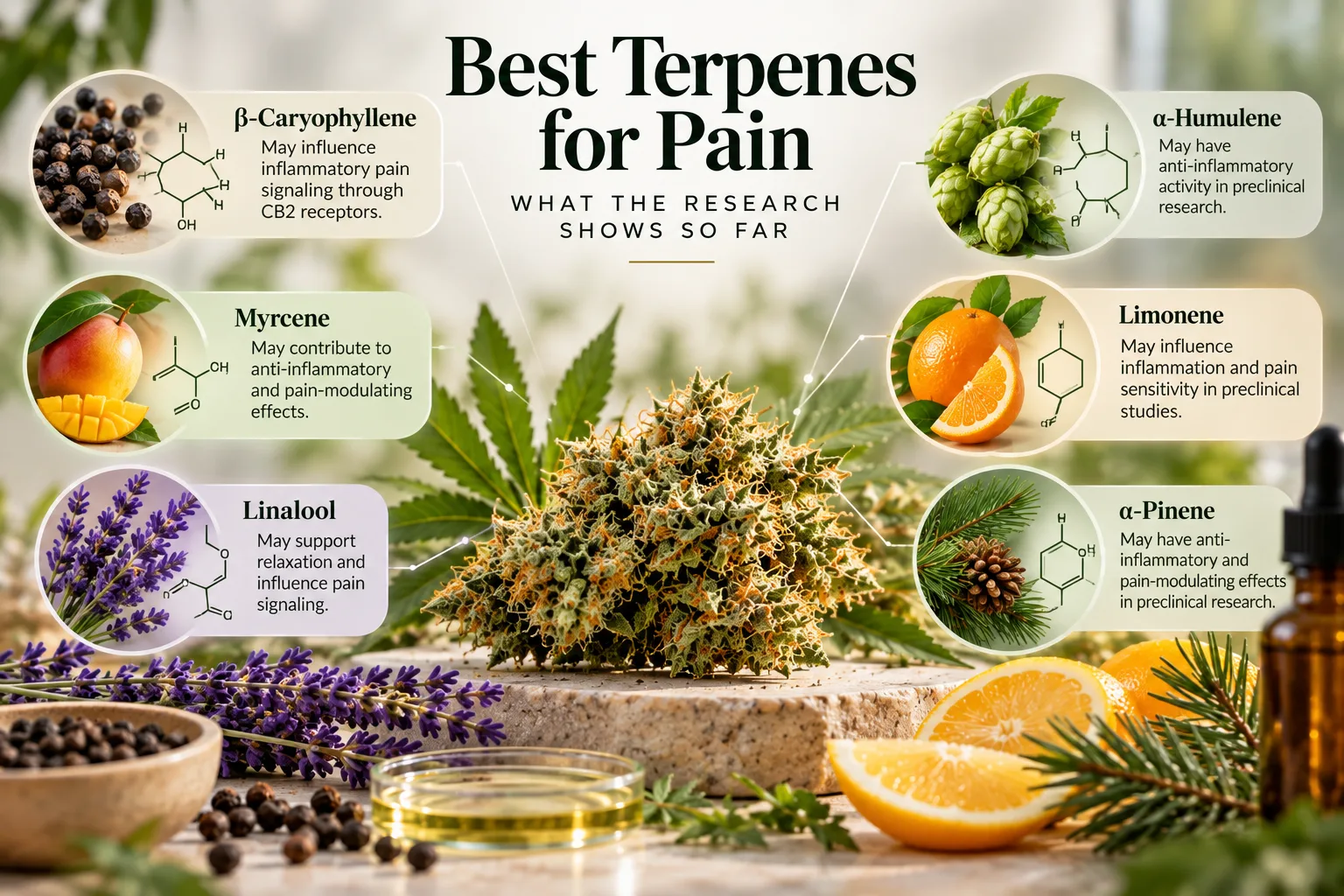
If any single compound leads a list of the best terpenes for pain, it’s beta-caryophyllene. The reason is structural. Most terpenes influence the body indirectly, but a 2008 study in Proceedings of the National Academy of Sciences found that beta-caryophyllene binds directly and selectively to CB2 receptors, one of the two main receptor types in the endocannabinoid system. It was the first compound outside the cannabinoid family shown to do this, and the researchers called it a “dietary cannabinoid.”
CB2 receptors sit mostly on immune cells and in tissues outside the brain, where they help regulate inflammation. CB1 receptors, by contrast, are concentrated in the brain and are what THC binds to when it produces a high. Because beta-caryophyllene targets CB2 rather than CB1, it doesn’t cause intoxication. That also answers a common question about which terpenes work with CB2 receptors: beta-caryophyllene is the standout, with the strongest evidence among common cannabis terpenes.
Beta-caryophyllene smells peppery, spicy, and slightly woody. You’ve already eaten it, since it’s abundant in black pepper, cloves, cinnamon, oregano, rosemary, and hops, and it’s approved as a food flavoring. In cannabis, it’s common in strains with a spicy or gassy nose.
Five More Terpenes Researchers Are Studying
Myrcene
Myrcene is often the dominant terpene in commercial cannabis, and it carries a reputation for being relaxing and pain-relieving. Research published in the National Library of Medicine suggests that myrcene may act as a cannabimimetic â meaning it can mimic and enhance the effects of cannabinoids like THC. This interaction may help amplify sedative and pain-relieving properties, making it a compelling area of study for natural wellness applications.
Myrcene smells earthy, musky, and herbal, with a hint of ripe fruit. It’s found in mangoes, hops, lemongrass, thyme, and basil. In Brazil, lemongrass tea has a long folk history as a soothing drink, which is partly what drew researchers to myrcene in the first place. The widely repeated claim that high-myrcene strains cause “couch-lock” hasn’t been confirmed in controlled studies, so treat that one as folklore for now.
Linalool
Animal research on linalool and pain is more extensive. In a 2025 University of Arizona study, geraniol and linalool significantly reduced fibromyalgia-type pain in mice, with effects lasting about two hours. Linalool is often promoted for conditions like fibromyalgia, arthritis, and migraines, but those claims run well ahead of the human evidence.
It smells floral and slightly spicy, and it also appears in coriander, basil, some mints, and certain citrus fruits. In cannabis, it tends to show up in smaller concentrations than myrcene or caryophyllene.
Humulene and Inflammation
Humulene gets its name from Humulus lupulus, the hop plant, and it gives beer its earthy, woody bitterness. Its main research story involves inflammation. A 2007 rodent study found that alpha-humulene, extracted from a Brazilian medicinal shrub, substantially reduced inflammation, with results the authors compared favorably to a steroid anti-inflammatory. That’s a big reason humulene’s anti-inflammatory potential keeps coming up in cannabis research.
More recently, the Arizona team found that geraniol and alpha-humulene significantly relieved post-surgical pain in mice. The lead researcher also drew a useful distinction: terpenes don’t appear to be a good option for acute pain from an injury like stubbing a toe, but his lab is seeing significant reductions in chronic or pathological pain. That matters for anyone researching cannabis terpenes for chronic pain, because it suggests their role may be different from that of a fast-acting pain reliever.
Pinene
Pinene is the most common terpene in the plant world, which is why a pine forest smells the way it does. It also shows up in rosemary, basil, dill, and citrus peels. Lab and animal studies suggest alpha-pinene has anti-inflammatory activity, and beta-pinene was one of the five terpenes that reduced nerve pain in the Arizona mouse studies.
Pinene is less studied for pain specifically than the others on this list. It’s included because it appears frequently in cannabis, contributes to overall terpene profiles, and shows consistent anti-inflammatory signals in early research. Among terpenes for inflammation, it’s one to watch rather than one with a strong track record.
Limonene
Limonene is the bright, citrusy terpene found in lemon, orange, and grapefruit peels, as well as juniper and peppermint. It’s one of the most common terpenes in cannabis, especially in strains with a sweet or sour citrus aroma. In rodent studies, limonene has shown anti-inflammatory activity and reduced pain responses tied to inflammation, although it’s been studied far less for pain than beta-caryophyllene or linalool.
Where limonene stands out is in how it may shape the THC experience. In a 2024 Johns Hopkins study, 20 adults vaporized THC with and without added limonene. Participants who received limonene alongside THC reported less anxiety and paranoia, and the effect grew stronger at higher limonene doses. That isn’t pain research, but it matters for people exploring cannabis for chronic discomfort. Many people, especially older adults and first-time patients, stop using THC because it makes them uneasy, and a terpene that may soften that reaction could make balanced products easier to tolerate.
Best Terpenes for Pain at a Glance
Here’s a quick reference for comparing the best terpenes for pain side by side, including where each one stands in the research.
| Terpene | Aroma | Also found in | What research is exploring | Evidence stage |
| Beta-caryophyllene | Peppery, spicy, woody | Black pepper, cloves, hops, rosemary | Direct CB2 activation, nerve pain, inflammation | Strong lab and animal data; limited human data |
| Myrcene | Earthy, musky, fruity | Mango, hops, lemongrass, basil | Pain signaling linked to natural opioid pathways | Early animal studies |
| Linalool | Floral, lightly spicy | Lavender, coriander, basil | Nerve and fibromyalgia-type pain; post-surgical aromatherapy | Animal studies plus small human trials |
| Humulene | Earthy, woody, hoppy | Hops, sage, ginseng | Inflammation and post-surgical pain | Animal studies |
| Pinene | Fresh pine | Pine needles, rosemary, basil | Inflammation and nerve pain | Lab and early animal studies |
| Limonene | Bright, citrusy | Citrus peels, juniper, peppermint | Inflammation in animals; reducing THC-related anxiety in humans | Animal studies plus one small human trial |
How Terpenes Work With and Without THC
A common follow-up question is whether terpenes work without THC. Based on current research, some of them appear to. Beta-caryophyllene acts on CB2 receptors on its own, and most of the animal studies above tested terpenes by themselves, with no cannabinoids involved. That’s one reason terpene-rich CBD products and non-intoxicating topicals have become popular with people who don’t want a high.
Terpenes may also interact with cannabinoids. In a 2021 University of Arizona study, combining terpenes with a synthetic cannabinoid reduced pain sensitivity in mice more than either did alone. That’s the core idea behind the entourage effect, the theory that cannabis compounds may work differently together than apart.
It remains an active research question rather than a settled fact, but it helps explain why many patients prefer full-spectrum products over isolates. If you want a refresher on how cannabinoids and terpenes differ, our cannabinoids and terpenes 101 guide lays out the basics in plain language.
Reading a Label for a Pain-Focused Terpene Profile
There isn’t a proven “best” cannabis terpene profile for pain yet, but there’s a sensible way to approach it. Start with the lab results rather than the strain name.
Many guides to the best terpenes for pain list specific strains as high in pinene or caryophyllene, but terpene content shifts from grower to grower, batch to batch, and even with how long a product has been stored. Large lab analyses of commercial cannabis have found that strain names are unreliable predictors of a product’s actual chemistry, so two jars labeled with the same name can smell and behave quite differently.
The certificate of analysis, or COA, is more dependable. Licensed California products are lab-tested, and many COAs list the top three to five terpenes along with their percentages. A product listing beta-caryophyllene, myrcene, or linalool near the top gives you a starting point that lines up with current research. Pay attention to totals, too. A product with 2.5% total terpenes contains far more aromatic compounds than one with 0.4%, even if both list the same terpenes.
After that, change one thing at a time. If you move from a myrcene-dominant flower to a caryophyllene-dominant one, keep the dose, method, and time of day the same so you can actually compare them. A few quick notes after each session, covering the product, the dose, and how you felt a couple of hours later, will show patterns much faster than memory. Finally, consider the type of discomfort.
Talking With a Budtender and a Healthcare Provider
Both conversations are worth having, and they cover different ground. A budtender knows the products: which ones have strong terpene profiles, which brands publish detailed lab results, and how different formats like tinctures, vapes, and topicals compare.
At Hello Cannabis Vista, it helps to come in with specifics. Mention the kind of discomfort you’re dealing with, whether you want to avoid feeling high, what you’ve already tried, and which aromas you’ve liked or disliked, such as citrusy versus earthy. Those details narrow the options quickly.
Terpenes won’t replace a pain management plan, and the best terpenes for pain are best understood as compounds worth exploring rather than proven treatments. Right now, they offer a more informed way to choose.